Find a spot that allows a night shift
Roborovskis often do their busiest work at night. A wheel, tunnel and bedding can make small sounds even when the hamster is quiet. A bedside table may be convenient for viewing and terrible for sleep.[1]
Use a stable shelf away from direct sun, drafts and constant bumps. A compact apartment does not need a huge animal room; it needs one dependable place for the enclosure.[2][3]
Treat the wheel as household sound
Choose a wheel that runs smoothly and position the enclosure on a steady surface. Do not remove the wheel to make the room silent. Change the placement or reduce vibration instead, so both your sleep and the hamster's activity have room.[1][3]
Make every opening escape-safe
In a small flat, one escape can lead straight under a sofa or through a door gap. Close the room, clear the floor and keep a transfer container ready before you lift the lid.[3][2]
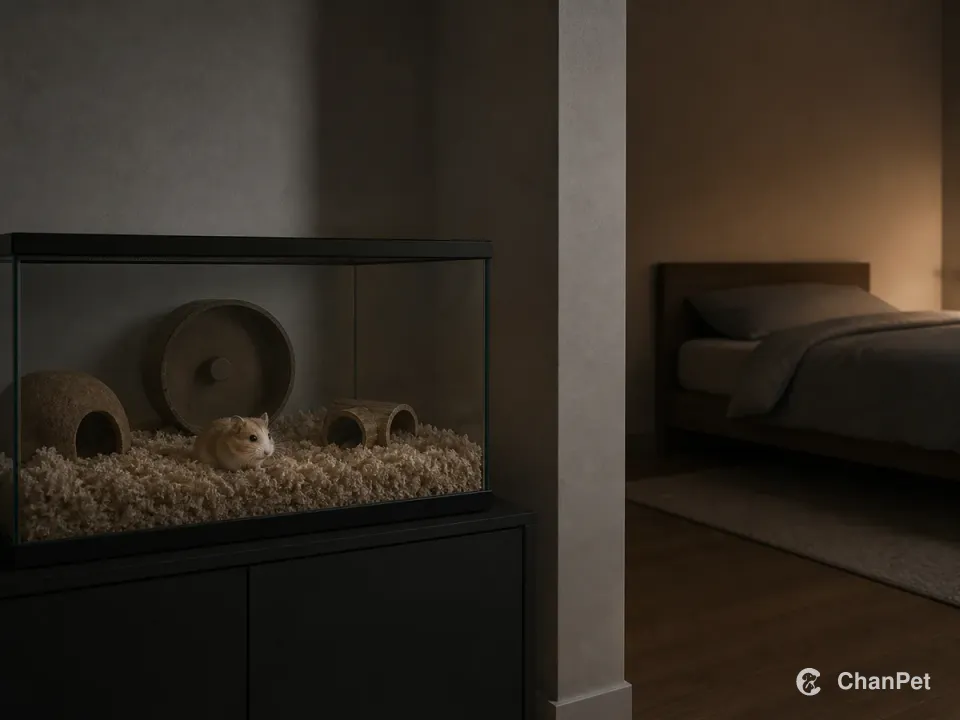
Place the secure habitat at a steady distance from the pillow, and the evening wheel routine and opening checks are easier to plan around.[1][3]
An apartment can work when the night routine is acknowledged
Separate your sleeping space from its active space
Good placement turns a night-time wheel into a manageable part of the home. A secure habitat and calm lid routine prevent most apartment surprises.[3][1]
Common questions
Sources
Sources used in this article
- [1]Phodopus roborovskii (desert hamster)Animal Diversity Web, University of Michigan Museum of Zoology
- [3]Preliminary investigation into the housing of dwarf hamstersRoyal Veterinary College and Veterinary Record
- [2]Caring for a hamsterAnimal and Veterinary Service, National Parks Board Singapore