Look up before you look around
A veiled chameleon uses branches and cover above the floor. Start the apartment plan by measuring upward space, then make room for a stable enclosure with routes and leaves inside it. A low, wide box on a media console does not match the way this animal uses its world.[1][2]
Choose a location that stays put. The enclosure should not move every time you host dinner, clean the room or rearrange a shelf. For a chameleon, a stable view and familiar routes through the habitat matter more than a place at the center of the room.[1][3]
Give air and water their own plan
Think through air movement, lights, water delivery and drainage before you install the habitat. You need a route to service each part without reaching across the chameleon or turning a routine check into a furniture move. A well-planned enclosure is easier to keep clean and easier to read.[2]
Do a real-life test of the location. Run the equipment when the apartment heating or cooling starts, when the bathroom door opens and when people are cooking. The goal is a stable enclosure inside a home that will always have its own changing air and temperature.[2][3]
Keep the corner out of household traffic
The chameleon does not need to join every activity in the apartment. It needs a place where people do not tap the enclosure, lift it for a closer look or send a curious cat toward the glass. Low disturbance is a feature of the home, not a sign that the animal is being ignored.[3][1]
If the only open area is beside the entry door, the television or the kitchen path, consider whether the apartment is ready for this species. A companion that can live more comfortably in the rooms you actually use may be a better choice.[2][3]
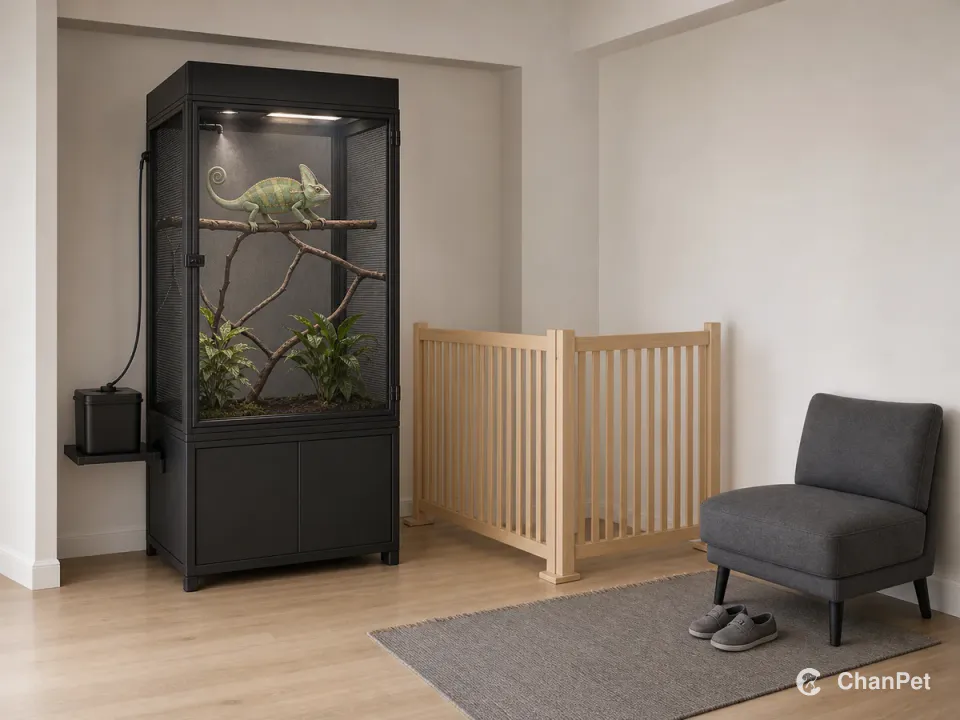
Fitting the tall enclosure is only the start; overhead clearance, airflow, water, and a quiet boundary from household traffic all need permanent room.[1][3][2]
A tall enclosure needs more than a tall wall
Compare pets around the space, household traffic and care setup your apartment can genuinely support.
The calmest corner is the useful one
Common questions
Can a veiled chameleon enclosure sit beside the kitchen or front door?
Why is vertical space important for a veiled chameleon?
Veiled chameleons are tree-dwelling reptiles that use branches and cover. A suitable home needs climbing height and routes, not only a clear patch of floor beside the aquarium or sofa.[1]
Sources
Sources used in this article
- [1]Chamaeleo calyptratus (Veiled Chameleon)Animal Diversity Web, University of Michigan
- [3]Do Veiled Chameleons Make Good Pets?World Wildlife Fund
- [2]Providing a Home for a ReptileMerck Veterinary Manual