Start with one quiet room
Bring the carrier into a prepared room and let the cat choose when to come out. Put water, food, a bed, a hiding place and a litter tray there before arrival. A new American Shorthair has plenty to take in without being passed from lap to lap.[1]
CFA describes the breed as adaptable and even-tempered, while individual cats still arrive with their own history. Sit nearby, speak normally and let a cautious cat watch you. A confident one may explore fast, but it also benefits from a quiet place to return to.[2][1]
Turn curiosity into a small hunting game
American Shorthairs are known for staying interested in movement. TICA notes that many enjoy games such as fetch. A wand toy dragged behind a chair or a treat hidden in a paper bag gives that alert, watchful side something to do indoors.[3]
Keep the game low to the ground at first. Let the cat stalk, pounce and catch the toy sometimes. End while it is still engaged, then put the toy away. That small rhythm makes play feel clear rather than turning your hands into prey.[3][1]
Learn the cat's quieter language
A cat who rubs against furniture, rests nearby or brings a toy may be asking for company in a low-key way. Stop before the tail starts flicking hard, the ears turn back or the body tightens. Respecting those small signals builds trust faster than forcing a cuddle.[1]
Use the same routine for meals, litter scooping and play during the first days. It gives a first-time owner a useful baseline. If appetite, litter habits or energy shift suddenly, you have something concrete to share with the veterinary team.[1][3]
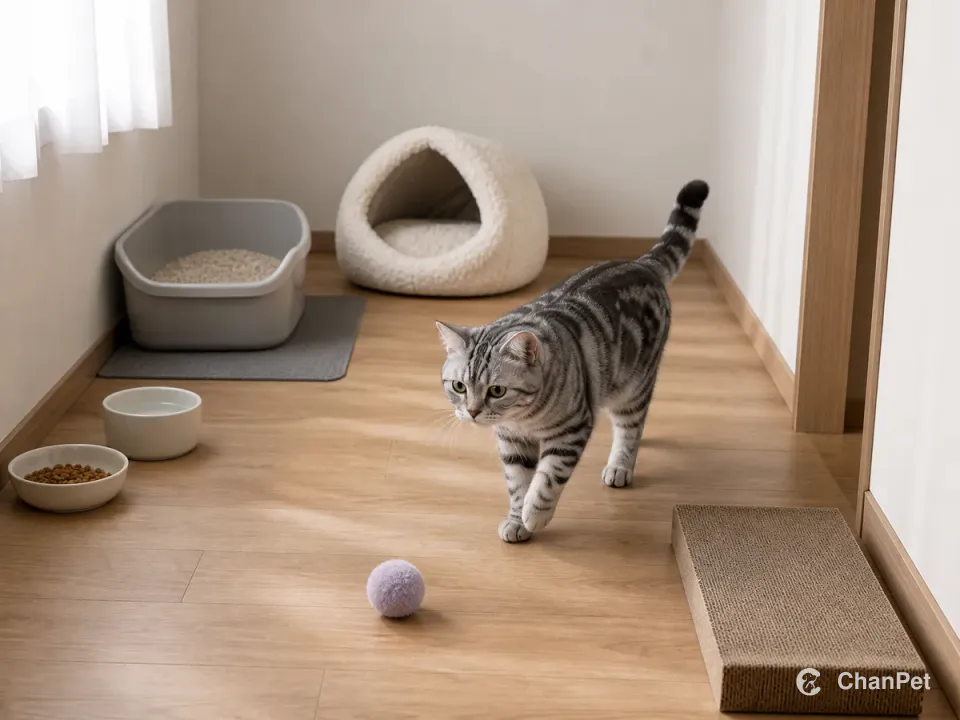
Keeping litter, food, water, a hide, and a short play moment in one quiet room gives the first week a clear rhythm.[3][1]
A good first cat for someone who likes a daily ritual
Picture the first ordinary evening
Thinking about an American Shorthair as your first cat? Use a smart match to compare your home, daily rhythm and appetite for play before you choose.
Common questions
Should a new American Shorthair meet everyone on day one?
Let the cat set the pace. A prepared quiet room gives it a base, and calm visitors can meet it later when it is moving around comfortably.[1]
What kind of play suits this breed?
Many American Shorthairs enjoy movement-based games, including fetch. Wand toys, rolled toys and simple food searches give them a chance to watch, stalk and catch.[3]
Sources
Sources used in this article
- [3]American ShorthairThe International Cat Association
- [2]American ShorthairThe Cat Fanciers' Association
- [1]Choosing and Caring for Your New CatCornell University College of Veterinary Medicine, Cornell Feline Health Center