Make looking the family activity
A dart frog can turn a family into better observers. Children can notice a frog moving through leaf litter, hunting tiny food or choosing a quiet spot. That is far more interesting than asking the animal to sit in someone's hand for a photo.[1][2]
Keep one clear rule: adults open the enclosure for necessary care. Children and visitors look from outside. This protects the frogs' calm routine and removes the pressure on a child to decide when an animal has had enough interaction.[1][3]
Give children observation jobs
A child can keep a small drawing or note of where the frogs were seen, when an adult fed them or when the enclosure was cleaned. Those tasks make the daily routine visible without transferring responsibility for food, temperature or health to a child.[2][3]
Use the notes to ask better questions. Did the frog come out at its usual time? Is the water system making a new sound? A family can learn that careful attention helps animals more than a burst of excitement ever will.[3]
Adults own the enclosure and hygiene
Adults need to manage food cultures, habitat checks, water, cleaning and any veterinary decision. They also need clean procedures around the enclosure and a plan for changes in a frog's condition. The technical work stays reliable when it has one clear owner.[3][2]
Talk about the species without turning it into a scary story. The most useful family message is simple: respect the frogs' space, keep hands and tools clean, and let adults handle the parts that affect their health.[1][3]
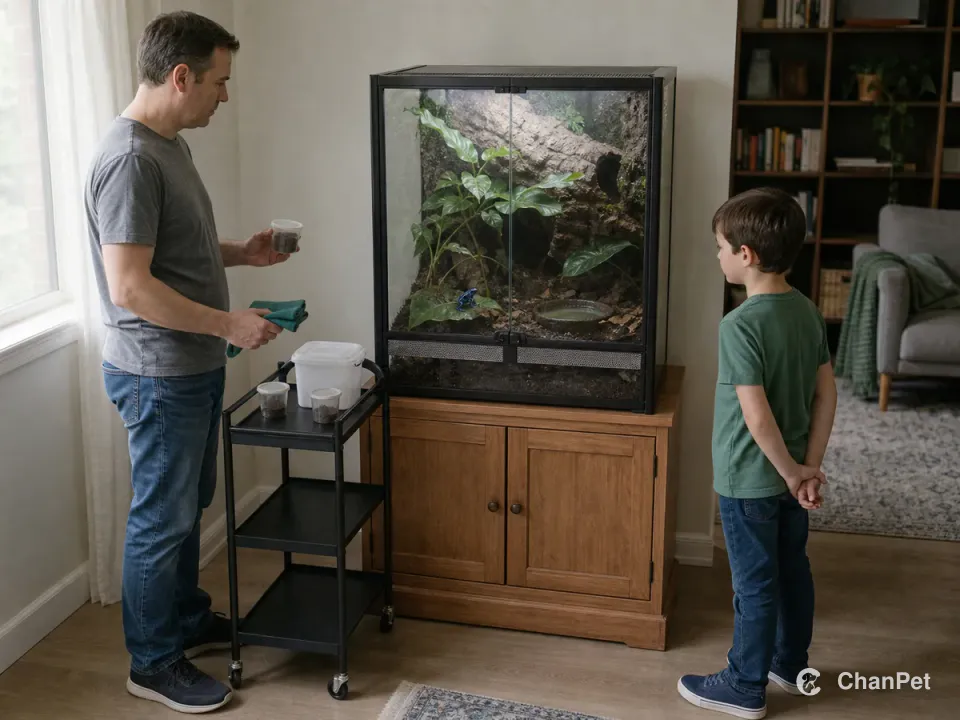
The adult owns food, cleaning and enclosure work; the child takes part by watching quietly with both hands outside the glass.[1][2][3]
Choose a family pet for the contact your family wants
Compare animals around the interaction style, care load and household structure your family can support.
The best family interaction may be a respectful distance
Common questions
Can children hold dart frogs?
Sources
Sources used in this article
- [1]Poison frogsSmithsonian's National Zoo and Conservation Biology Institute
- [2]Poison Dart FrogSacramento Zoo
- [3]Dart Frog CareChicago Exotics Animal Hospital