Make watching the family activity
A green tree python has plenty to show from inside its own world. Smithsonian describes adults resting coiled on branches and hunting at night. Children can watch a perch choice, a nighttime movement, or a quiet feeding routine without requiring the snake to leave its habitat.[1]
Make the glass the family boundary. Adults open the enclosure for planned care, while children and guests view from outside. That protects the snake's normal posture and makes the family routine easier to explain and repeat.[1]
Give children observation jobs
Children can keep a simple observation log with an adult. They might draw the enclosure, note where the snake rested, or record when an adult fed or cleaned. These tasks create real participation without shifting delicate habitat decisions onto a child.[1]
Use the notes to talk about animal needs. Why does the python rest on a branch? Why is it more active after dark? Why do adults plan access before opening the door? Those questions teach respect for an animal's routine.[1]
Make clean hands the end of every task
Reptiles and their habitats can carry germs even when the animal looks healthy. Adults should make soap-and-water handwashing the fixed finish after contact with the enclosure, food, tools, or the snake. Keep this rule close to the habitat so guests can follow it too.[2][3]
Keep enclosure and feeding supplies away from human-food preparation. ARAV and CDC guidance support clear hygiene boundaries around reptiles. A dedicated care bin helps adults complete a task without leaving a tool where a child could mistake it for household equipment.[2][3]
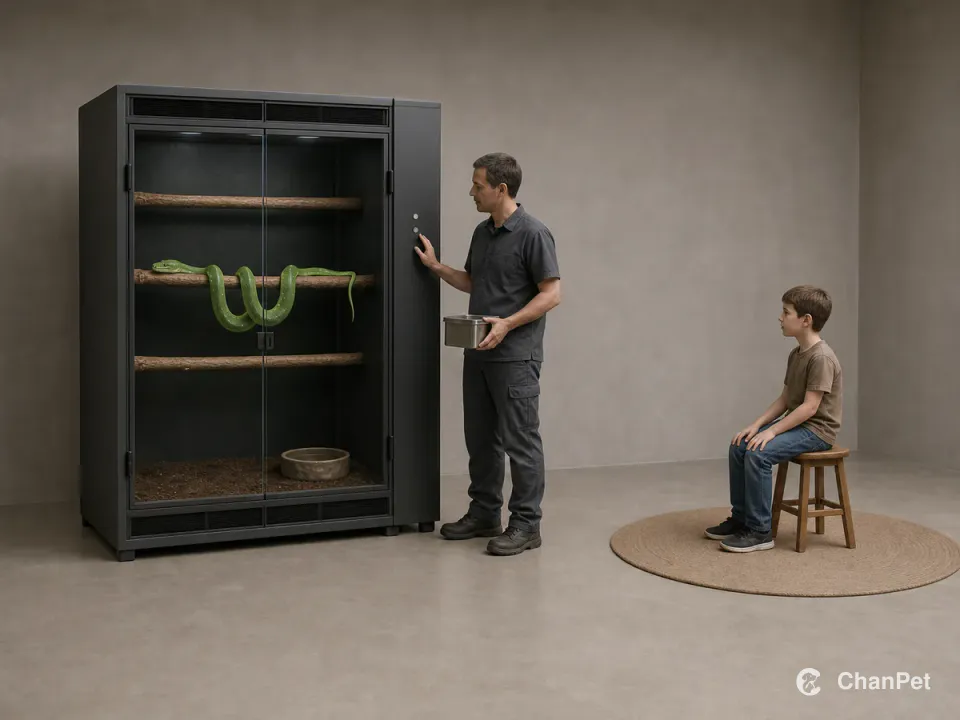
Adults own the habitat and hygiene; children observe from a clear boundary instead of handling the python.[1][2][3]
Choose this python for observation, not family handling
Compare animals around your family's preferred interaction, hygiene routine, and the adult care you can sustain.
The best family contact can be a respectful view
Common questions
Can children hold a green tree python?
Sources
Sources used in this article
- [1]Green tree pythonSmithsonian's National Zoo and Conservation Biology Institute
- [2]Reptiles and AmphibiansCenters for Disease Control and Prevention
- [3]Salmonella in Reptiles and Amphibians: Veterinary GuidelinesAssociation of Reptile and Amphibian Veterinarians