Teach observation before feeding
A family can notice a surprising amount just by looking together. Which fish travel together? Is the filter flowing? Has anyone stayed apart from the group? A small notebook makes those questions feel like a game without turning the glass into a toy.[1]
Fish welfare guidance connects regular water monitoring with a suitable aquatic environment. Adults can explain what they are checking, while keeping the interpretation and any adjustments in capable hands.[1]
Make feeding a measured job
Prepare the feed amount before a child comes to the tank. This lets them participate without repeating the fun part until the food becomes a water-quality problem.[1]
Wash hands after touching the aquarium, its water, equipment or waste, and before snacks or other household activities. CDC recommends handwashing as a basic practice around animals and their environments.[2]
Adults manage the group when it changes
Guppy social life changes when males and females share a tank. Research has documented persistent male sexual attention and shifts in female social associations. That is interesting to observe, but it also calls for adult planning.[3]
Decide before purchase whether you will mix sexes, what you will do with fry and how the aquarium will stay within its limits. Children can help record changes; adults make the decisions that affect every fish.[3][1]
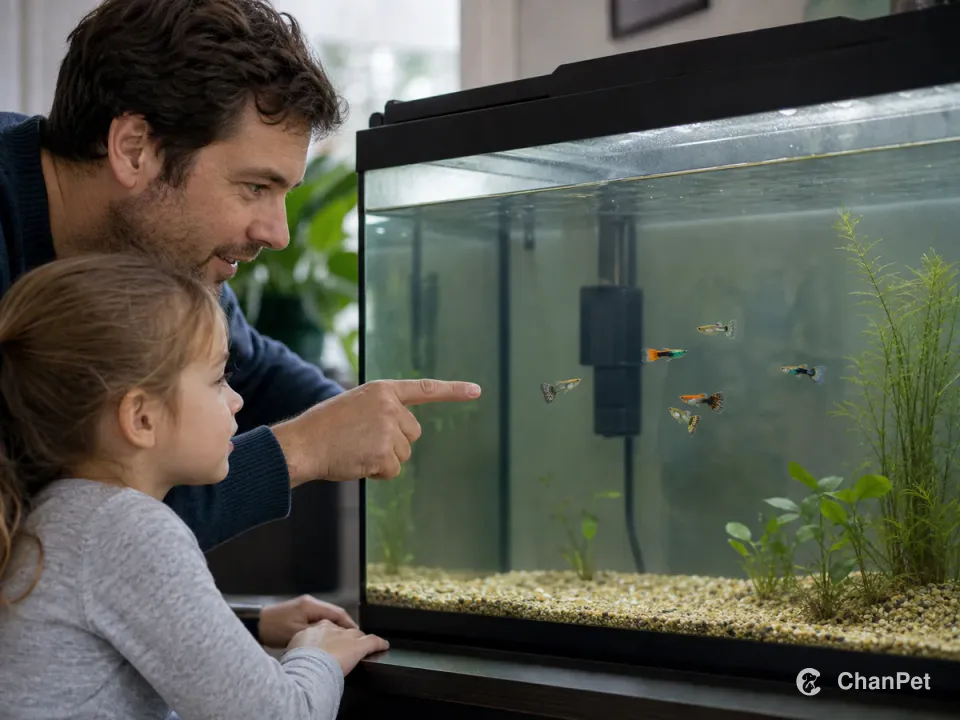
Start by looking at how the group swims and rests. Observation itself is care that children can take part in.[1][2]
A fit for families with clear roles
Give curiosity a safe place to grow
Let children watch, record and help with prepared feed. Let adults protect the water, equipment and fish group. That division gives a guppy tank its best family rhythm.[1][3]
Common questions
Sources
Sources used in this article
- [1]Fish Welfare in Public Aquariums and Zoological CollectionsAnimals
- [2]Hygiene Practices Around AnimalsCenters for Disease Control and Prevention