Give children a real job that stays gentle
A child can become the observer: What did the snail eat? Where did it travel? Is there a new mark on the shell? They can place washed food in the dish after an adult prepares it. That is real participation without turning the snail into a toy.[1]
Adults take responsibility for the enclosure, substrate, cleanup and health decisions. RSPCA advises gentle moving, ideally when a snail is on the substrate or after it has crawled onto a leaf. A child who loves the snail also learns to pause before touching it.[1]
Put handwashing right after the observation
Keep soap and a towel on the route out of the care area. CDC advises washing hands after handling animals, their habitats, their food and their supplies. A visible routine works better than calling a child back after they have reached the snack drawer.[2]
Keep the enclosure away from eating and food-preparation spaces. This simple boundary helps the whole family remember the sequence: enjoy the snail, finish care, wash hands, then move on.[2][3]
Make observation the fun part
A snail has plenty to watch when its enclosure works well. Families can notice how it follows a damp path, chooses food or disappears into the substrate. Try offering a safe leaf or hide and let the animal choose what to do.[1]
The slower pace gives children a useful lesson: a small animal has limits even when it does not say so. Research on pet giant land snails also supports treating hygiene as part of responsible contact, rather than an afterthought.[3][2]
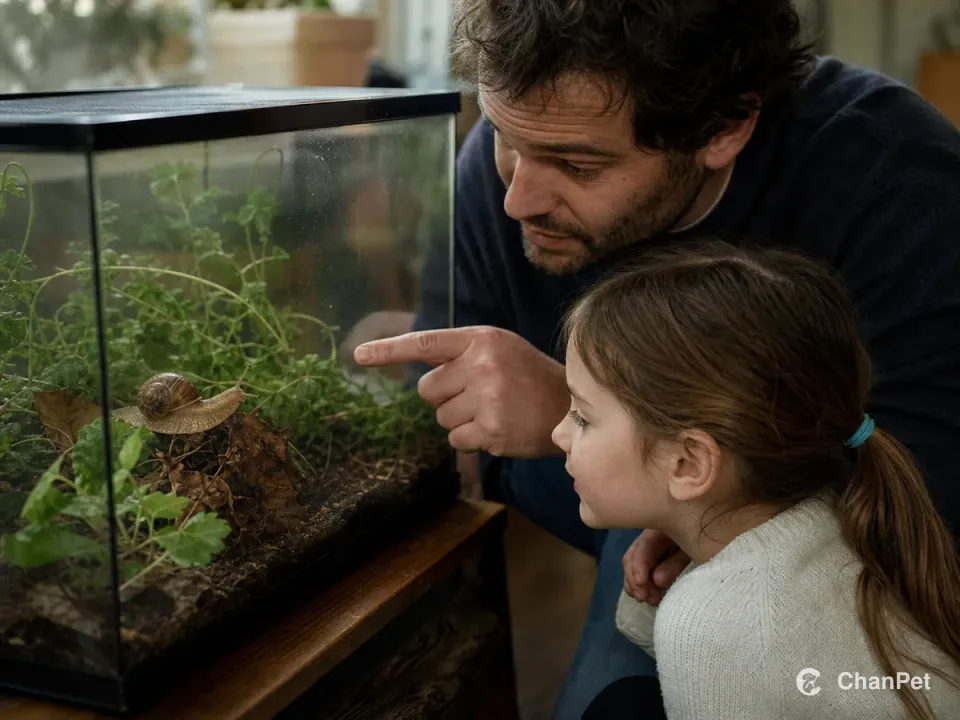
Watching through the glass lets children see the snail closely while keeping contact and cleanup easier to manage.[1][2]
Let adults carry the care and children share the discovery
A quiet animal can create very good family time
Watching a snail explore, preparing a leaf and washing hands together is already a complete family activity. Adults keep the habitat healthy, and children get to notice a small animal with real care needs.[1][2]
Common questions
Can a child hold a snail for a long time?
Keep contact short and adult-led. Let the snail stay on the substrate or crawl onto a leaf when it needs moving. Frequent lifting brings more risk than value.[1]
Sources
Sources used in this article
- [1]Giant African land snailsRSPCA
- [2]Hygiene Practices Around AnimalsCenters for Disease Control and Prevention
- [3]Occurrence of Rhabditid Nematodes in the Pet Giant African Land SnailsJournal of Parasitology Research / PubMed Central