A few minutes prevents the avoidable problems
The daily task can be brief: look at the lid, water, enclosure condition and the spider's usual area. The point is not to make the animal perform. It is to spot a loose opening or a leftover feeder while the fix is still simple.[1][2]
A jumping spider can cover a surprising distance in a moment. Washington State University describes this family as compact and active. A quick check is how a small pet stays a contained pet on your busiest week.[2][1]
Live feeders remain part of the job
The classroom guide from UF uses small insects to demonstrate jumping-spider hunting. At home, that becomes a recurring errand and a small bit of judgment. You need an appropriate feeder available when the spider is ready, not a last-minute substitute.[3][1]
Keep each feeding legible. Offer a suitable feeder, see how the spider responds and remove a remaining insect when safe. That leaves you with a useful record instead of a crowded enclosure that tells you very little.[1][3]
The retreat changes what you do
A silk nest can be a place to rest or molt. When it is occupied, the care job often becomes smaller: maintain the outside conditions and leave the retreat alone. It is a poor time to redecorate or chase a better photograph.[1]
Make a note when the spider stops appearing as usual, and look for obvious injury or an accidental escape route. If a real concern develops, those notes are more useful to an experienced exotic-animal professional than a vague memory.[1][2]
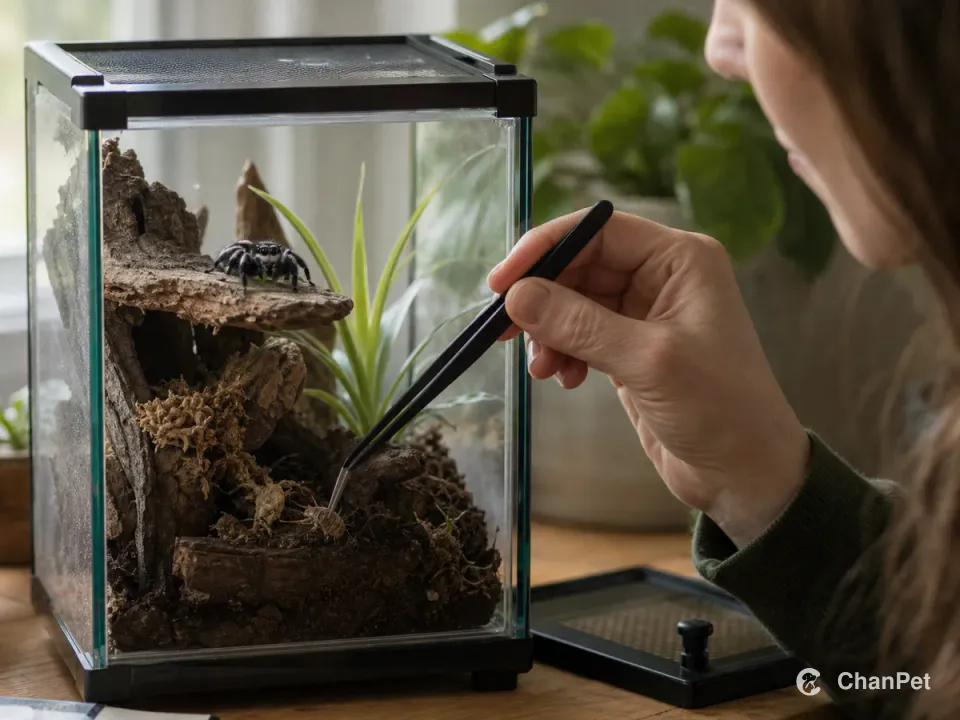
Good low-maintenance care is brief, deliberate and gentle.[1]
Good for a busy person who still looks closely
Give the small jobs a regular slot
The routine is light when you treat it as a routine. Put the enclosure check and feeder plan into a predictable part of your week, and the spider stays a quiet companion rather than an overlooked project.[1][2]
Sources
Sources used in this article
- [1]Regal Jumping Spider, Phidippus regius C. L. KochUniversity of Florida IFAS Extension
- [3]Guide to Collecting and Maintaining Live Arthropods for Classroom Display in FloridaUniversity of Florida IFAS Extension
- [2]Jumping spidersWashington State University Extension