Placement does more work than decor
Terrestrial isopods need damp, cool, shaded conditions to avoid drying out. A sunny sill, a heating vent and direct air conditioning can turn a tiny enclosure into a different habitat within hours. Choose a stable spot away from heat and fast airflow.[1][2]
Do not judge the spot only once. Check the enclosure at two different times of day: its outer temperature, substrate surface and the places the colony is using. In a small home, that simple habit reveals a problem before you have to guess at one.[2][3]
A lid is part of husbandry, not a way to trap air
Isopods are small enough to use substrate and gaps in ways people overlook. A well-fitted lid helps keep the colony and its humidity together. It still needs species-appropriate airflow; sealing an enclosure completely simply trades one problem for another.[1][2]
Substrate, leaves and tiny animals can travel with houseplants, soil, compost and rubbish. Research describes terrestrial isopods moving in exactly those materials. Treat the enclosure and its contents as one unit when you tidy or move, rather than tipping them outside on impulse.[3]
A small space makes subtle changes easier to notice
Apartment living does not prevent good observation. A container that stays in one place makes it easier to notice where animals gather, whether leaf litter is being used and when tiny young appear. That kind of record teaches you more than a larger decorative setup.[3][1]
If every possible spot is hot, sunny or beside a strong vent, there is no need to rush into a colony. Find the stable corner first. Then bring the animals into a home that is ready for them.[2][1]
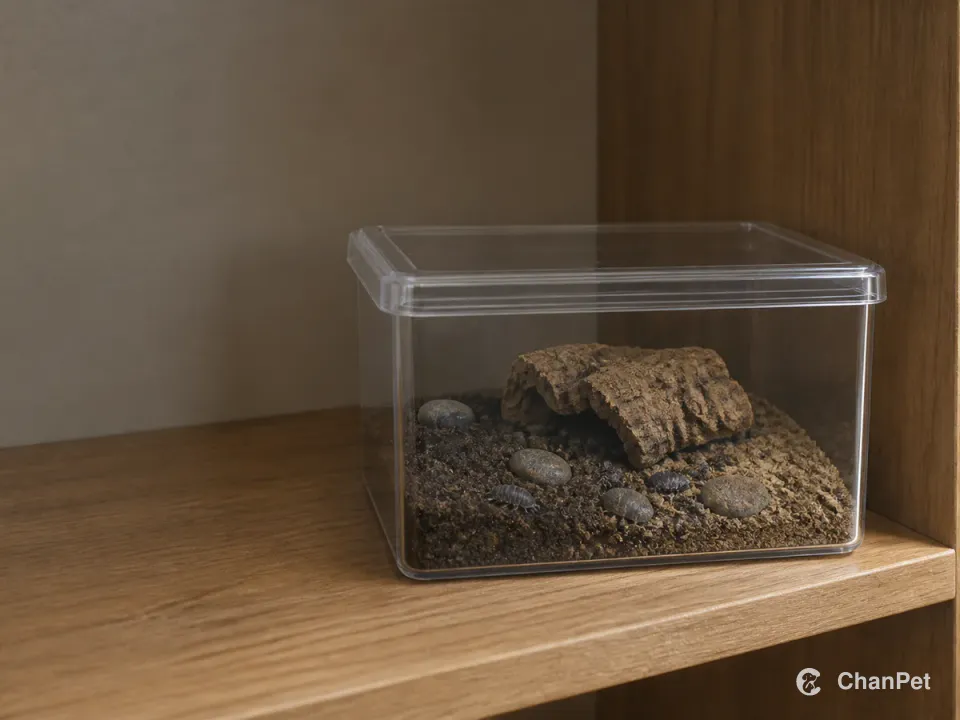
An interior shelf away from sun, heating and dry airflow helps the small habitat keep a steadier moist side.[1][2]
Give the colony a corner untouched by household weather
Apartment isopod care wins through stability, not size
Keep the enclosure away from sun, heating and dry airflow, then observe and adjust gently. With that foundation, isopods can be a quiet apartment companion.[1][3]
Common questions
Sources
Sources used in this article
- [1]Introduction to Invasive Terrestrial IsopodsPenn State Extension
- [3]Terrestrial isopods in urban environments: an overviewZooKeys
- [2]Some Relative Humidity Reactions of the Wood-Louse, Cylisticus convexusThe Great Lakes Entomologist