An apartment is a route through the day, not just a room count
With a Rottweiler, the pressure points in a building are often the transitions: the front door, the corridor, the elevator, the parking area and the moment a neighbor turns a corner. A compact, powerful dog needs calm movement and clear handling in those tight spaces. That matters more than any promise that the dog will simply stay quiet indoors.[1][2]
Start by mapping the route your dog will take several times a day. Where can you pause without blocking people? Which door opens into a busy path? Is there a place to wait while a visitor enters? The answers shape the home setup. A gate, a mat and a practiced wait can make an arrival predictable. They are more useful than trying to hold a strong dog still after surprise has already taken over.[2]
The workday needs a dog plan, not a hopeful gap in the calendar
Apartment dogs cannot use a yard as a substitute for contact and outdoor time. Before choosing a Rottweiler, look at the least convenient workday: who takes the dog out, what happens when transport is delayed, and who can step in when a meeting runs late? A routine that works only on ideal days will feel fragile quickly.[1][3]
Being left alone is a skill, not a test of whether a dog can endure a long absence. The RSPCA recommends building it gradually and watching for hidden signs of distress, such as pacing or whining. A short video from time to time can reveal what the dog does after the door closes. If there are signs of distress, shorten the step and get help rather than punishing the mess or the noise after you return.[3]
Outings should give the dog a job without turning into a battle
A good apartment routine has more than a quick toilet break. It can include a measured walk, time to investigate scent, a few useful training repetitions and a chance to settle afterward. The aim is not to wear the dog out through endless intensity. It is to make the outside world understandable and to return home with a dog that has had an appropriate outlet.[1][2]
Recall and lead skills deserve early practice in controlled settings. The RSPCA advises building recall with rewards and using a long training lead where appropriate rather than giving complete freedom before the behavior is reliable. In a shared residential area, that kind of preparation gives you more options when a door opens or another dog appears.[4]
Visitors need a routine that protects everyone’s breathing room
Do not make every arrival a social event for the dog. A resting place behind a gate or in another room gives you time to answer the door, speak with a visitor and decide whether an introduction is suitable. Some dogs enjoy meeting people; others do better with distance. The important part is that the household does not ask the dog to make that choice while being crowded in an entryway.[2]
The same principle helps when the day has been busy. A Rottweiler does not need every evening to be crowded with activities. Quiet recovery, a predictable sleeping place and a handler who can recognize when to give the dog space are part of making apartment life feel stable.[1][3]
Questions to settle before moving forward
- Can the dog enter and leave the building without being rushed through tight shared spaces?
- Is there a daily outdoor routine that still works during bad weather and a hard work week?
- Can the dog learn gradual alone time instead of being left to cope without preparation?
- Do you have a calm visitor plan that does not rely on people crowding the dog at the door?
- Is there a backup person who understands the same routes and handling rules?
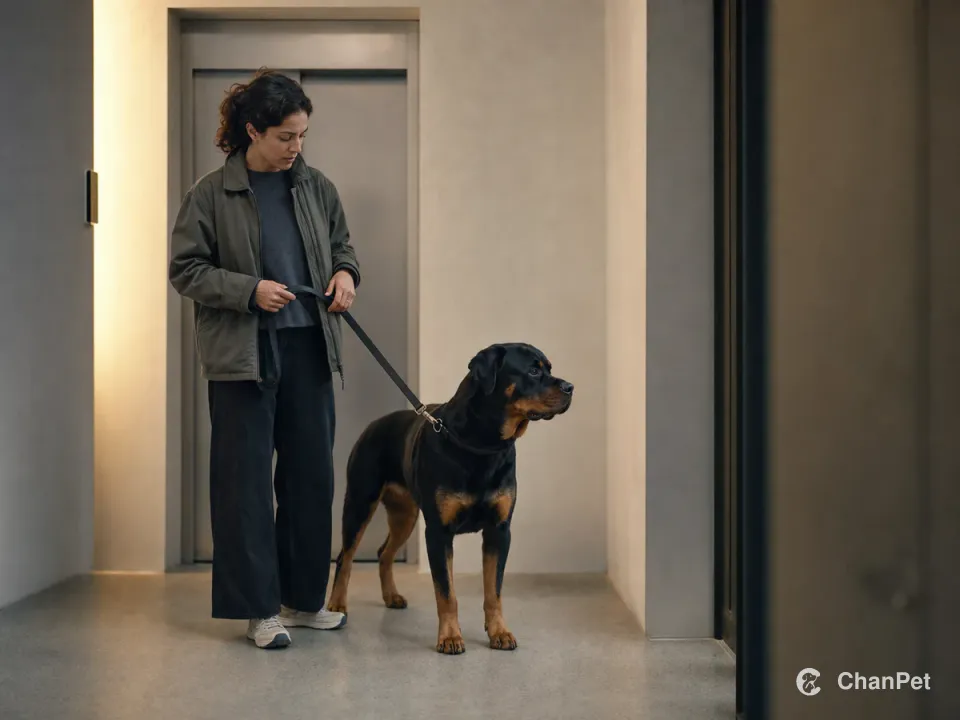
Short apartment routes are easier when they are rehearsed in calm moments.[2][3]
When apartment life can be fair to this dog
An apartment can be a good home for a Rottweiler when the people in it can manage the building calmly, schedule meaningful outdoor time and protect the dog’s rest. If entries are chaotic, absences are unplanned or every encounter in the corridor feels like a gamble, the problem is not the apartment label. It is the missing routine.[1][2][3]
Put your apartment into the picture
Considering a Rottweiler in an apartment? Put your home layout, entry route and daily routine into the match. It shows what needs planning before the dog moves in.[1][3]
Common questions
Does a larger apartment make a Rottweiler suitable automatically?
How can I tell whether my dog is coping when left alone?
Watch for changes such as pacing, whining, toileting indoors or destructive behavior. The RSPCA suggests checking with video from time to time because some signs are easy to miss otherwise.[3]
Sources
Sources used in this article
- [1]FCI Standard No. 147: RottweilerFédération Cynologique Internationale
- [2]AVSAB Position Statement on Humane Dog TrainingAmerican Veterinary Society of Animal Behavior
- [3]How to Train Your Dog to Stay Home AloneRSPCA
- [4]Train Your Dog To Come When CalledRSPCA