Make observation the main event
Children can learn a lot from watching a blue-tongued skink bask, look for food and choose a hide. Ask what they notice each day. That is more interesting for the lizard, and often more memorable for the child, than a quick turn holding it.[1]
A skink that puffs up, opens its mouth, hisses or displays its blue tongue is asking for space. Teach children that backing away is the correct response. Reading that signal is a better family skill than trying to make every interaction happen.[1]
One adult should own the habitat
The adult needs to own light replacement, temperature checks, food planning and veterinary decisions. LSU research found that UVB exposure affects vitamin D markers in this species. Children can help notice changes, but the environmental decisions need an adult.[2]
Keep three rules short: ask before opening the enclosure, leave the tail alone, and wash hands after contact. Short rules hold up when a visiting friend is excited and the room gets noisy.[1][3]
Wash hands before snacks or toys
CDC says reptiles and their environment can carry germs. After touching the skink, a dish, substrate or a tool, wash hands with soap and water before touching faces, toys or food.[3]
Young children, older adults and people with weakened immune systems need extra caution around reptiles. Keep the enclosure outside kitchen areas, store cleaning tools separately and give the family one clear wash-up routine.[3]
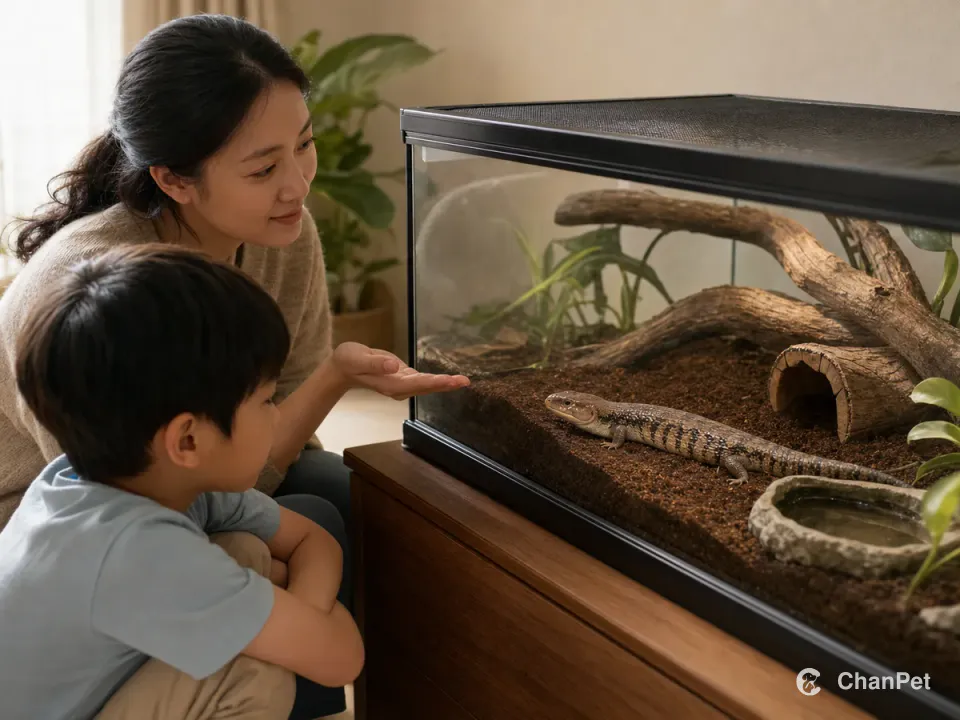
Watching the skink move in its habitat helps children learn its boundaries before they ask to handle it.[1][3]
Children join in; adults protect the routine
The best family interaction is learning the skink's language
Children learn to pause and watch. Adults keep the habitat and hygiene steady. That gives a blue-tongued skink a calmer home and gives the family a real shared project.[1][3]
Common questions
Sources
Sources used in this article
- [1]Northern blue-tongued skinkSmithsonian's National Zoo and Conservation Biology Institute
- [3]Reptiles and AmphibiansCenters for Disease Control and Prevention
- [2]Measuring the Rise and Fall of Plasma 25-Hydroxyvitamin D Concentrations in Blue-Tongued Skinks (Tiliqua scincoides) Following Ultraviolet B Exposure and WithdrawalVeterinary Sciences / Louisiana State University School of Veterinary Medicine