Friendly still needs a frame
AKC describes Labradors as friendly, outgoing and energetic. That can look like a whole body arriving at once when someone walks through the door. Adults should teach the dog that greetings happen with four paws on the floor, and teach children to stand still instead of squealing, running or pushing the dog away.[1][2]
Keep adult supervision in the room whenever young children and the dog play. RSPCA advises watching their interactions and giving dogs space around food, toys and rest. Those boundaries let a Labrador stay part of family life without asking children to read every small signal on their own.[2]
Give the dog a resting place
Set up one bed or mat that belongs to the Labrador. Teach children that a dog on that bed gets left alone. The rule works during a noisy birthday party, the evening rush and the quiet afternoon when the dog has already had enough interaction.[2]
Watch for the dog's choice to step away, turn its head or settle on the mat. Those are useful moments for an adult to end the game kindly. A family dog does not have to entertain everyone all the time. Rest is part of the routine too.[2][1]
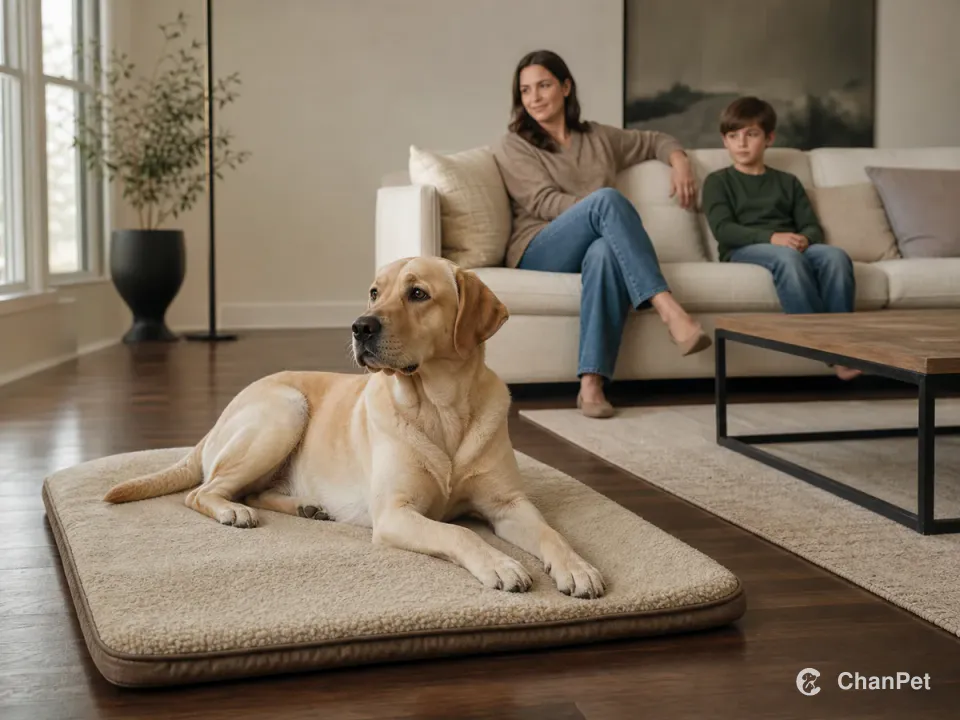
The dog's mat gives a busy family a clear pause point.[2][1]
A family dog when adults keep the structure
Write the family rules before the dog arrives
Want to see whether your children, home and daily rhythm suit a Labrador? Start a smart match and compare the practical parts together.[1][2]
Common questions
Can children walk a Labrador Retriever?
What should children do when a Labrador is eating or sleeping?
Give the dog space. RSPCA advises adults to supervise children and dogs, especially around food, toys and resting places.[2]
Sources
Sources used in this article
- [1]Labrador Retriever Dog Breed InformationAmerican Kennel Club
- [2]Children and Dogs: How They Can Live TogetherRSPCA
- [3]DogsCenters for Disease Control and Prevention