The best family interaction is often through the glass
Land hermit crabs give children something real to watch: a crab testing a shell, finding cover or shifting its routine after dark. That kind of attention can be more rewarding than passing a small animal from hand to hand.[1][2]
Give children a job that fits the animal. They can make a quiet observation log, help offer food with an adult, or point out a new shell choice. Adults decide when the enclosure opens and how the environment is maintained.[1][2]
Make handwashing the family rule
The rule can stay simple: after touching the crab, food, water dishes, substrate or enclosure tools, wash hands before eating. CDC advises thorough handwashing after contact with animals and their environments, with adults supervising younger children.[3]
Keep the enclosure supplies separate from the kitchen and snack area. CDC explains that animals and animal environments can carry germs even when they look clean. A clear routine keeps that fact from becoming a source of worry.[4][3]
The adult commitment stays after the novelty fades
A child's interest can rise and fall quickly. The enclosure still needs water, food, cover and quiet during a busy week. Adults should decide in advance who continues that work when school, sports or a new hobby takes over.[1]
LHCOS places welfare and natural behavior at the center of its care ethic. In family terms, that means the crab's hiding, digging and shell choices matter more than turning it into a prop for a visit or a photograph.[2]
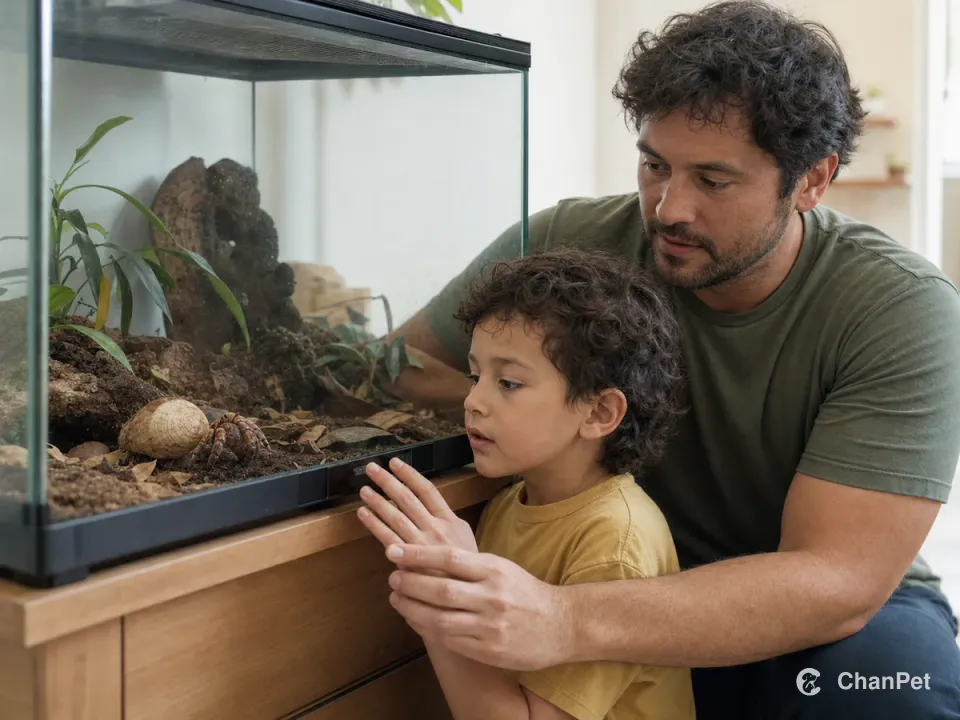
An adult sets the pace while the child observes through glass; enclosure work and hygiene remain adult responsibilities.[3][2]
Let the child join the care, not carry it alone
Give children the wonder; keep the responsibility with adults
A well-run enclosure can invite patient curiosity. Adults protect that experience by keeping the habitat steady, setting hygiene rules and respecting the crab's need for cover.[1][2]
Common questions
Sources
Sources used in this article
- [1]How Do You Build a Home for Hermit Crabs?Smithsonian's National Zoo and Conservation Biology Institute
- [3]Hygiene Practices Around AnimalsCenters for Disease Control and Prevention
- [4]Preventing Salmonella InfectionCenters for Disease Control and Prevention
- [2]Land Hermit Crab Owners Society Member Code of EthicsLand Hermit Crab Owners Society