Finish the setup before you choose the animal
A first land hermit crab should arrive at a finished home, not a shopping list. Smithsonian's keepers use fresh and saltwater pools, deep ground cover and cover for digging. Those pieces let the crab use the enclosure instead of merely surviving inside it.[1]
Set the enclosure in its future spot and live with it for a few days. Can you reach the water without moving furniture? Does sunlight hit the glass? Is an air vent close by? A beginner learns a lot before the crab arrives.[1]
Learn the small signs before you need them
At first, watch rather than interpret every movement. A crab may explore, change shells, visit water, dig, or stay hidden. The useful record is simple: water condition, food left behind, activity and any obvious damage to the animal or shell.[1][2]
Some changes call for faster help. An animal out of its shell, an injury, or a sharp decline in activity deserves a call to a veterinarian who sees exotic pets. Veterinary literature on hermit-crab emergencies treats husbandry and safe handling as part of the clinical picture.[3]
Give molting space the benefit of the doubt
Digging is not a problem to fix. It is one reason the substrate needs depth and the enclosure needs quiet. Leave the crab's hiding place alone while you maintain the visible parts of the habitat around it.[1][4]
That restraint is part of beginner skill. You are caring for a small animal with its own timing, not trying to produce a daily show. LHCOS frames natural behavior and safe habitat choices as the basis of ethical care.[4]
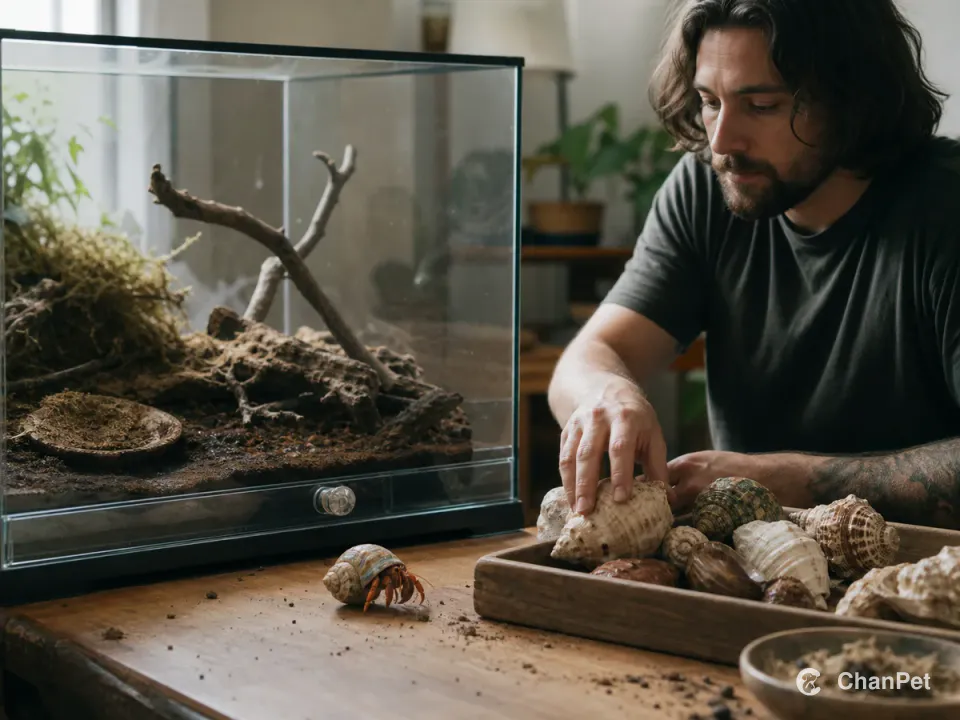
Preparing deep substrate and spare shells first keeps the crab's first week focused on water, food and quiet observation.[1][4]
Let the first week be quiet
The first success is a stable enclosure
When you can keep water, food, shells and substrate in order on an ordinary week, you have a real foundation for a first land hermit crab. The purchase can wait until that feels routine.[1]
Common questions
Sources
Sources used in this article
- [1]How Do You Build a Home for Hermit Crabs?Smithsonian's National Zoo and Conservation Biology Institute
- [2]Land hermit crab (Coenobita clypeatus) densities and patterns of gastropod shell use on small Bahamian islandsMissouri State University / Journal of Biogeography
- [3]Tarantula and Hermit Crab Emergency CarePubMed / Veterinary Clinics of North America: Exotic Animal Practice
- [4]Land Hermit Crab Owners Society Member Code of EthicsLand Hermit Crab Owners Society