A family dog is still an adult job
Children running past, arguing over toys or calling a dog into the middle of a game can change the mood quickly. Adults need to notice when the dog turns away, stiffens or chooses distance, then pause the game and give it a quiet place to go. A large, strong dog is easier for everyone to live with when those decisions stay with adults.[1][2]
The CDC reminds families that any dog can bite, especially when frightened, nervous, eating, playing or protecting something valuable. Young children should always be supervised around dogs, including familiar family dogs. This is not a judgement on a dog or a child. It is a simple acknowledgement that ordinary family moments can change quickly.[2]
Make boundaries visible enough for children to understand
Give the dog a resting place that children do not enter. Do not use a sleeping, eating or hiding dog as an opportunity for a cuddle, a photograph or a lesson in bravery. Teach children to call the dog over rather than chase it. They should leave food and toys alone, and end an interaction before the dog needs to ask for distance.[2][3]
Keep the rules short enough to use every day: no climbing, no hugging, no teasing, no taking possessions, and no approaching a dog that is asleep or eating. The goal is not to make children nervous around the dog. It is to give them a clear, respectful way to share a home with an animal that also needs choice and rest.[2]
Early learning should not look like a crowd around a puppy
For a Rottweiler puppy, family socialization can mean learning that children moving around the house, a baby gate closing, a stroller passing or a visitor at the door are ordinary events. AVSAB identifies the first three months as important for safe socialization, while warning against overwhelming puppies with experiences that cause excessive fear, withdrawal or avoidance.[4]
Let the puppy watch from a comfortable distance, take breaks and choose whether to approach. A calm, well-managed interaction is more valuable than asking every child at a party to touch the dog. If the puppy looks worried, the adults should create space rather than tell the puppy to tolerate it.[4][3]
Hygiene is part of family care, not an afterthought
Dogs can carry germs even when they look healthy. The CDC recommends washing hands after touching a dog, its food, its bowls, waste or supplies, and before eating or preparing food. Young children need adult help with that routine. Cleaning waste promptly and keeping feeding areas separate from places where people eat are everyday habits that make a family home easier to manage.[2][5]
Hygiene should be taught as a normal part of affection, not as a reason to make the dog seem dirty or unsafe. A child can help refill water under supervision, then wash hands. An adult handles waste cleanup and veterinary decisions. Matching tasks to a child's age keeps the dog from becoming an unplanned responsibility placed on the smallest person in the home.[5][2]
Read the individual dog, not a family-dog label
The dog in front of you matters more than a family-dog label. Health, past experiences, training and the current home all shape behavior. When a dog tries to leave, freezes, stiffens or avoids contact, make room and seek help before the pattern becomes harder to manage.[1][3]
A calm Rottweiler does not need to be placed in the center of every family activity. Rest, predictable outings and quiet time are part of a good relationship. A household that can respect those pauses is more likely to give the dog a stable place in family life.[1][4]
Before the dog arrives, agree on these family promises
- Adults, not children, remain responsible for lead handling, veterinary care and behavior decisions.
- The dog has an undisturbed resting place and children know it is not a play area.
- Every interaction between young children and the dog is actively supervised.
- Handwashing, food handling and waste cleanup have clear adult-led routines.
- The household uses calm, reward-based training rather than teasing, shouting or rough play.
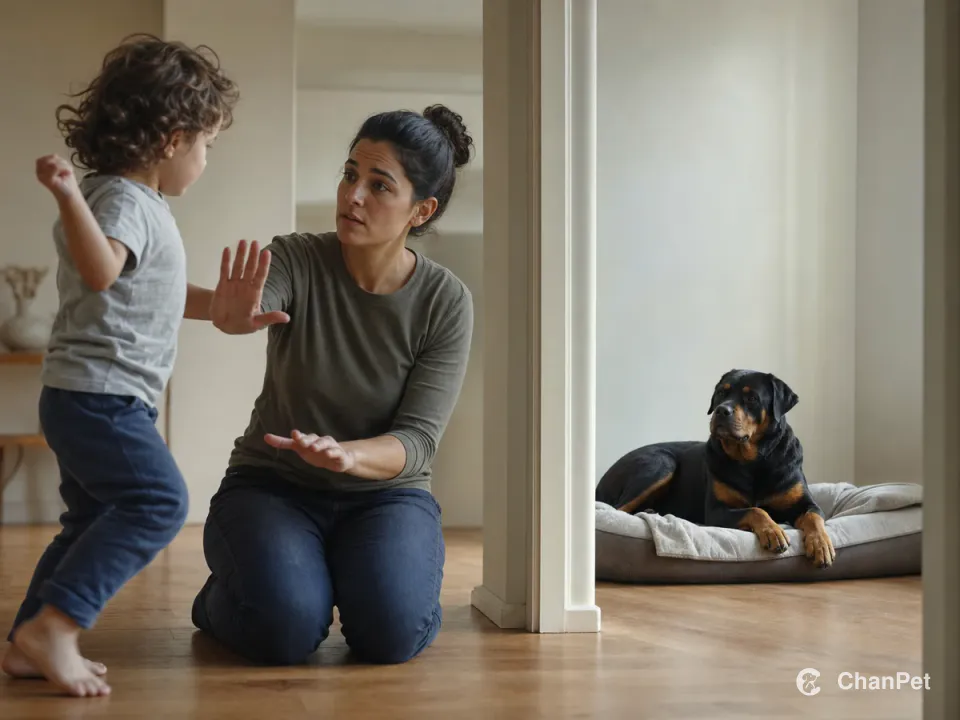
Adults set the distance, pace and rest space when children and dogs share a home.[2][3]
A good family fit is built in the routine
A Rottweiler can be a devoted part of family life when adults set the pace, supervise closely and protect the dog's rest. The dog does not need to entertain children or stay in the middle of every activity. A home that makes room for calm, choice and consistent rules gives everyone a fairer start.[2][1][3]
Make the family plan concrete
Thinking about a Rottweiler for a family with children? Put your household routine, supervision and care roles into the match. It shows how the plan needs to work each day.[2][3]
Common questions
Can children help care for a Rottweiler?
Is a friendly-looking dog safe to leave alone with a young child?
No dog should be left unsupervised with a young child. The CDC specifically advises supervising young children around dogs, even trusted family pets.[2]
Sources
Sources used in this article
- [1]FCI Standard No. 147: RottweilerFédération Cynologique Internationale
- [2]Dogs | Healthy Pets, Healthy PeopleCenters for Disease Control and Prevention
- [5]Hygiene Practices Around AnimalsCenters for Disease Control and Prevention
- [3]AVSAB Position Statement on Humane Dog TrainingAmerican Veterinary Society of Animal Behavior