Make feeding a planned job
The fish will often swim toward the glass when people enter the room. That is charming, and it can make every child want to feed them. Keep food with the adult who measures it, then let one person feed at the planned time while everyone watches the fish respond.[1]
A family feeding rule keeps the tank easy to read. Everyone knows when food was offered, and adults can see whether a fish eats as usual. It also keeps leftover food from turning a sweet family moment into extra work for the water system.[1]
Give kids things to notice
Set up a small notebook beside the aquarium. A child can draw the fish, note which one came to food first, or mark a water-change day on the calendar. Those jobs teach attention without turning the tank into a toy or a contest.[1]
Goldfish research has explored how substrate affects foraging behavior in aquarium fish. You can use that idea as a prompt for observation: where does the fish spend time, how does it explore, and what changes after normal tank maintenance? Children often notice details adults miss when they are given a specific question.[2]
Adults run the water system
Adults should own water tests, filter care, equipment checks and decisions about adding fish. Lionhead goldfish research shows that stocking density has real effects. Choosing how many fish live together is a care decision, never a reward for a child who asks at the pet store.[3][1]
Make a family plan for holidays and busy weekends as well. One adult needs to know the tank's routine and a second person should know where the notes and supplies are. That lets the aquarium remain a source of calm, even when the rest of the house is loud.[1]
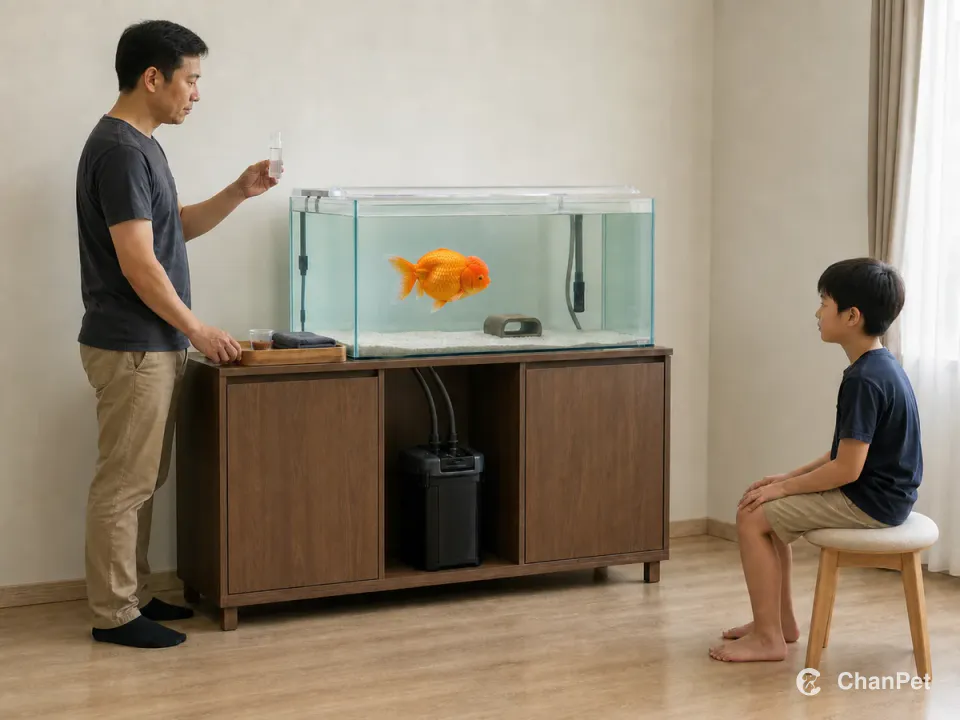
Adults manage water and measured feed; children observe quietly beyond the tank's care boundary.[3][1][2]
Let the fish invite curiosity, not impulse
The best family aquarium has clear roles
Keep feeding and water care in adult hands, then make room for children to notice the fish's daily life. That balance protects the tank and gives the whole family something real to learn from together.[1][2]
Common questions
How can children help with a Thai lionhead goldfish tank?
Why should a family avoid adding fish on impulse?
Adding fish changes the aquarium's care load. Lionhead goldfish research shows that stocking density matters, so adults should make additions only after considering space, filtration and water management.[3]
Sources
Sources used in this article
- [3]Effect of different stocking densities on lionhead goldfish (Carassius auratus) nurseryRMUTSB Academic Journal
- [1]Routine Health Care of FishMerck Veterinary Manual
- [2]Goldfish in a tank: the effect of substrate on foraging behaviour in aquarium fishAnimal Welfare / Cambridge University Press