Quiet for neighbors, sensitive to the room
A land hermit crab will not bark through a shared wall or need a late-night walk. That makes apartment life easier. The enclosure itself still reacts to the room around it: a sunny windowsill, an air-conditioning blast and a heater can all change conditions quickly.[1][2]
Land hermit crabs use water and keep moisture in their shells. Research on Coenobita clypeatus describes water balance as part of its land life. For an apartment keeper, that is a practical reminder to look at the enclosure rather than judging humidity by how the room feels.[3]
Choose a corner that stays boring
The best enclosure spot is usually the least dramatic one. It is away from direct sun, reachable for water changes and clear of a busy path. Once it is in place, avoid shifting it around every time you rearrange a room.[1]
Use the first week of a new setup to notice the local pattern. Check it after the building heat comes on, after a hot afternoon and after a window has been open. You are learning the corner before an animal depends on it.[3]
Moving day needs its own plan
Rental life eventually brings a move, renovation or power problem. New Jersey's animal-emergency guidance points out that large glass hermit-crab enclosures are awkward to move in an emergency. It recommends preparing a lidded temporary container, food, water and hiding materials ahead of time.[4]
Make the same plan for a routine move. Decide where the temporary container goes, who carries it, and who restores water and enclosure conditions at the destination. A move feels much calmer when those answers are written down.[4]
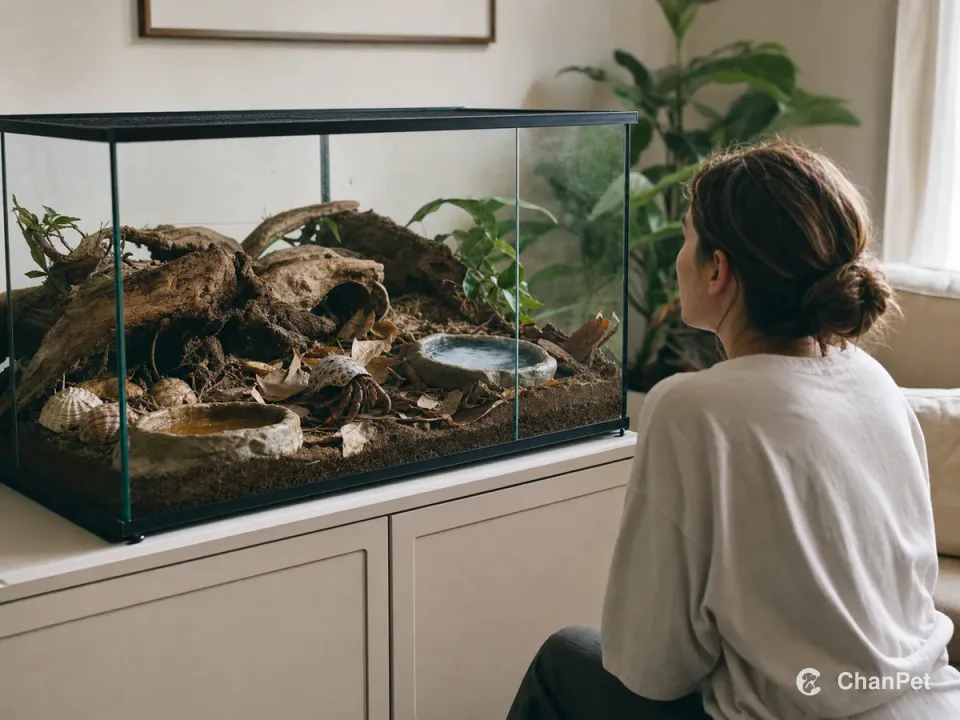
A stable enclosure corner needs digging depth, places to hide, and room for the habitat to stay undisturbed in an apartment.[1][3]
A small footprint still needs a steady life
The apartment test is simple: can the enclosure stay put?
A quiet crab can fit a quiet apartment. Give the habitat a secure place, watch the room conditions and plan the next move before it is urgent.[4][3]
Common questions
Sources
Sources used in this article
- [1]Land hermit crabSmithsonian's National Zoo and Conservation Biology Institute
- [3]On the ecology of Coenobita clypeatus in Curaçao with reference to reproduction, water economy and osmoregulation in terrestrial hermit crabsNaturalis Biodiversity Center
- [4]Hermit Crabs: Animal Emergency PreparednessNew Jersey Department of Agriculture
- [2]Land Hermit (Coenobita clypeatus)U.S. Fish & Wildlife Service