Let household traffic show you the plan
Notice where people rush past each other at breakfast and when they come home. A perch by a quieter window, a covered bed near the sofa and a shelf outside the hallway can give the cat choices away from those busy paths. The goal is a home with places to pause.[1]
Tortoiseshell coloring arises from coat-color genetics. It cannot choose a perch for your cat. Watch which room it returns to after the first few days, then move or add resources where they help the cat use the apartment with confidence.[2][1]
Put scratchers on the cat's path
A scratcher hidden behind a chair rarely solves a sofa problem. Offer a stable vertical post where the cat wakes or stretches, and a flat option near another route. The cat will quickly show you which surface earns regular use.[1]
Keep a light toy close to one of those spots. A short play break can redirect energy toward a safe part of the room. You are giving the cat a useful activity, rather than trying to make an apartment look permanently untouched.[1]
Give the box privacy without hiding it
Choose a litter location with a quiet entrance, an exit route and enough space for you to clean it. Avoid placing it beside food, water or a loud machine. Cornell notes that cleanliness, location, household changes and health can all affect box use.[3]
Keep supplies within arm's reach. A scoop that lives beside the box is easier to use than one stored in another room. When cleaning is convenient, the litter area is more likely to remain inviting for the cat.[3]
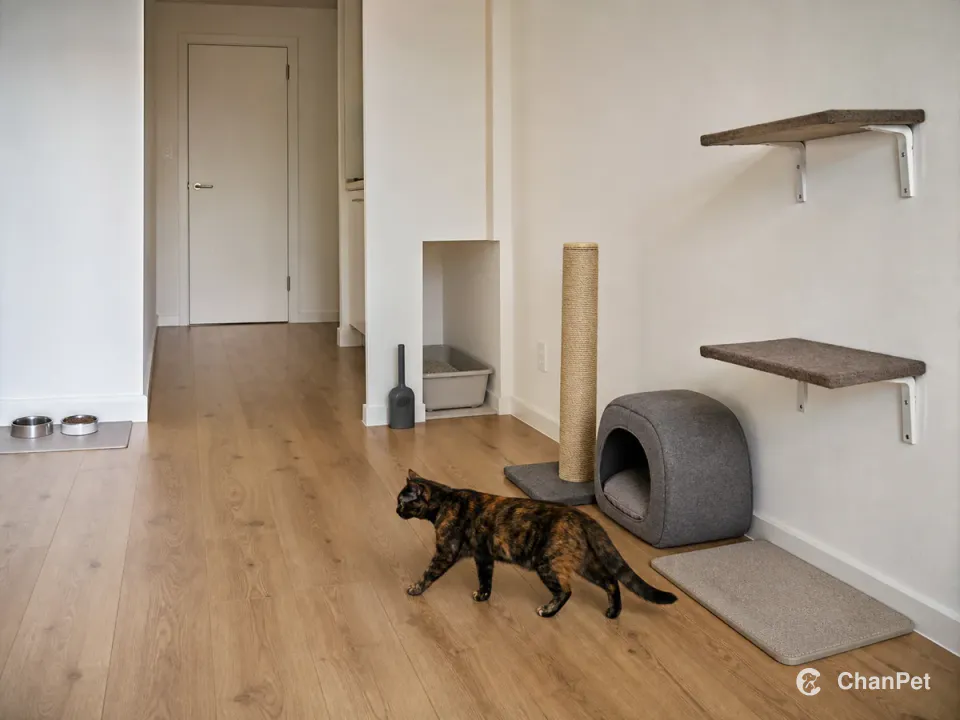
A clear central walkway stays open while a quieter wall route links the litter alcove, scratcher, covered bed and supported platforms.[2][1][3]
A compact home needs clear cat choices
Small spaces work when they have clear jobs
Give the cat a pathway through the apartment, not just a collection of objects. Food, rest, scratching and litter each need a dependable spot that makes sense to the cat.[1][3]
Common questions
Can a tortoiseshell cat be happy in a small apartment?
What makes a litter box spot work in an apartment?
Choose a quiet, reachable site away from food and loud vibration. Keep it clean and note any sudden change in the cat's litter habits for a veterinary conversation.[3]
Sources
Sources used in this article
- [2]Calico Cat and X-Chromosome InactivationUniversity of Michigan, Kalantry Laboratory
- [1]Your Cat's Environmental Needs: Practical Tips for Cat CaregiversFeline Veterinary Medical Association and International Cat Care
- [3]Feline Behavior Problems: House SoilingCornell University College of Veterinary Medicine, Cornell Feline Health Center