Build two places, not one tank
A slider needs water to swim in and a platform it can climb onto and dry off on. Set the platform up before you buy the turtle. Watch whether it stays dry above the water line and whether the turtle would have a steady route up to it.[1][2]
Put the enclosure where you can reach it for water changes without carrying buckets through your home. A beautiful tank becomes tiring fast when every clean-out means moving heavy water around furniture.[1][2]
Treat the lights as care equipment
The warm basking area and the UVB fixture have separate jobs. Check the fixture, its distance, and the dry platform as a set. It is easier to make a safe layout while the enclosure is empty than after a turtle has learned where it rests.[1][3]
A veterinary study in red-eared sliders found that ultraviolet exposure affected a vitamin D measure in the turtles. That is a useful reminder that UVB is part of habitat planning, rather than a decorative lamp to add later.[3]
Learn the water routine while the tank is empty
Run the filter, heater, and thermometer for a few days. Listen for a rattle, look for drips, and learn how you will remove old water. Aquatic reptile care depends on water quality, so equipment problems belong in the setup stage.[2][1]
Keep a small note of temperature, feeding, water changes, and any unusual behavior once the turtle arrives. You are building a baseline. That makes a change easier to describe if you need help from a reptile veterinarian.[2][1]
The first setup afternoon
- Choose the tank's permanent location and a surface that can support it.
- Set up the swimming water and a dry, reachable basking platform.
- Run heat, filtration, and UVB as one enclosure system.
- Practice the water-change route before the turtle depends on it.
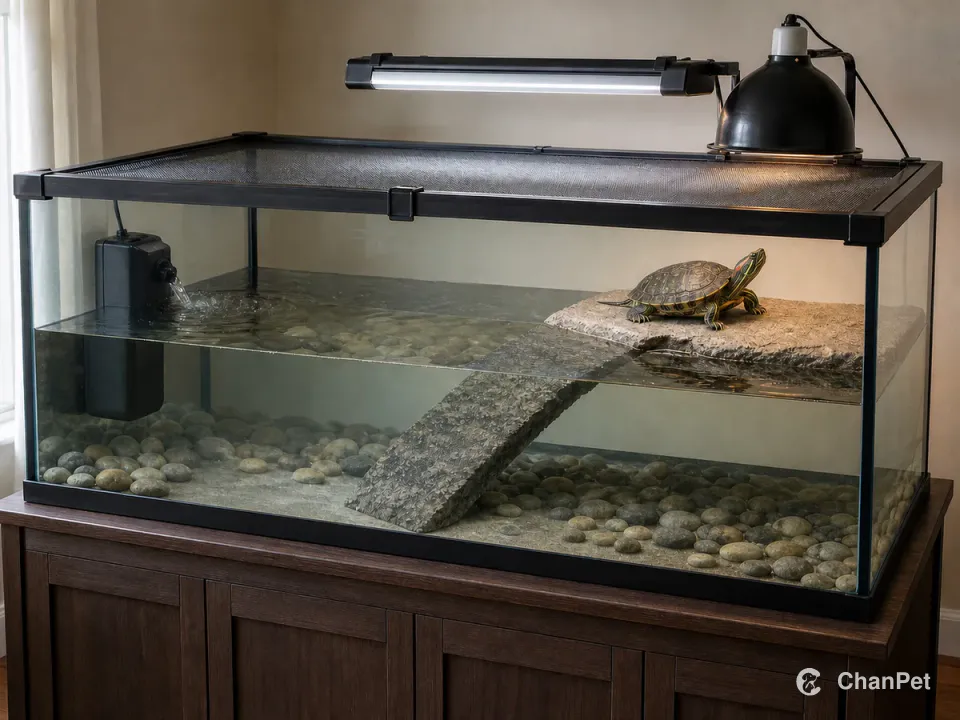
A beginner first brings together swimmable water, filtration, a continuous ramp, a dry basking area, heat and UVB. Regular checks and cleaning then become part of the weekly routine.[3][1][2]
A first turtle for a hands-on keeper
The turtle comes after the habitat
A dry dock, working lights, stable water, and an easy cleaning route give a red-eared slider a better beginning than a quick purchase. Set those pieces up first, then bring the turtle home.[3][1][2]
Common questions
Can a red-eared slider live in water with no dry platform?
Why set up UVB before the turtle comes home?
It lets you check the fixture and the basking layout calmly. Red-eared slider research also links ultraviolet exposure with a vitamin D measure, so the lamp belongs in the care plan from the start.[3]
Sources
Sources used in this article
- [3]Effects of ultraviolet radiation on 25-hydroxyvitamin D3 synthesis in red-eared slider turtles (Trachemys scripta elegans)American Journal of Veterinary Research / Louisiana State University School of Veterinary Medicine
- [1]Providing a Home for a ReptileMerck Veterinary Manual
- [2]Husbandry and medicine of aquatic reptilesSeminars in Avian and Exotic Pet Medicine