Let the first room do real work
A Bengal will notice the top of a bookcase before you have put down your keys. Start in one quiet room with a carrier opening, water, food, litter, a scratcher and a covered place to rest. Keep those things apart. The room gives a new cat an easy map while you learn whether it eats, uses the tray and comes out to explore.[1]
Do not make the first evening a meet-and-greet. Sit nearby, speak normally and let the cat decide when it wants to investigate. A Bengal's curiosity often shows up quickly, but a new home is still a lot to take in. A calm start makes the cat's ordinary behavior easier to read.[1][2]
Make play part of your evening
TICA describes Bengals as active, inquisitive cats that enjoy climbing and interaction. That is the part a first-time owner should take seriously. Put a stable cat tree where it can be used every day, and keep a few toys that move like small prey. Short, focused games are more useful than buying a basket of toys and hoping for the best.[2]
Try a simple rhythm: a chase, a pause, a catch, then a quiet finish. Put wand toys away when you are done. Over a week or two, you will see what the cat actually likes: a toy dragged around chair legs, a ball sent down the hall, or a perch near the window. That information is more useful than a generic shopping list.[2]
Take the paperwork seriously
Before a kitten or adult cat comes home, ask to see vaccination, parasite-control and medical records. For Bengals, also ask about PRA-b testing. UC Davis describes PRA-b as a testable inherited, progressive retinal disease in the breed. The records give your veterinarian a useful starting point rather than a story pieced together later.[3][1]
Bring the papers to a routine veterinary appointment after arrival. Mention the food the cat has been eating, any medicines, and anything you noticed during the first few days. You are not expected to diagnose a cat. You are giving the veterinary team a clean picture of the cat you have just welcomed home.[1][3]
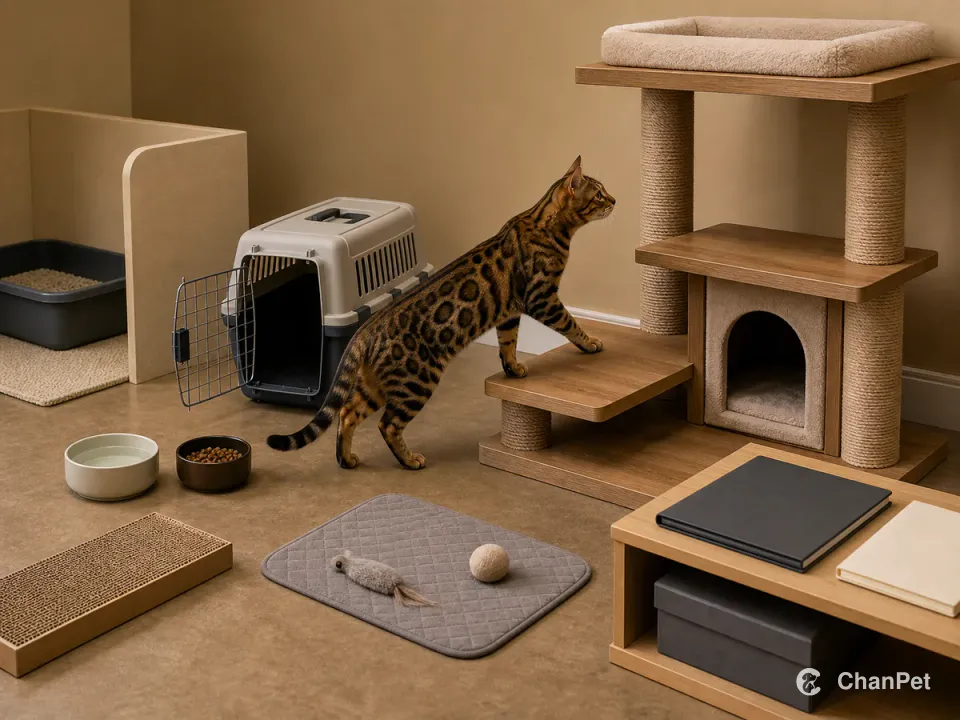
Prepare the climbing route, retreat, separate daily resources, and health file before arrival so the new cat can explore the base room at its own pace.[2][3][1]
A first cat for someone who wants to join in
Picture the evening, not the adoption photo
Want to test whether your home has room for a playful, climbing cat? Start a smart match and compare your time, space and current pets before you choose a Bengal.[2][1]
Common questions
Should I let a new Bengal explore the entire home on day one?
Start with one prepared room, then open more space as the cat eats, uses the litter tray and explores comfortably. This keeps essential resources easy to find and lets you observe the early routine.[1]
Sources
Sources used in this article
- [2]BengalThe International Cat Association
- [3]Progressive Retinal Atrophy (PRA-b) (Bengal)University of California, Davis Veterinary Genetics Laboratory
- [1]Choosing and Caring for Your New CatCornell University College of Veterinary Medicine, Cornell Feline Health Center